There are affiliate links on this page.
Read our disclosure policy to learn more.
Phone Scam: Did you receive call from Megan at AT&T, 743-223-8420 saying your discounted rate ends today
Email and Online Scams -
Have You Received a Scam Phone Call?
Megan at AT&T, 743-223-8420, claiming "your 50% discount on your monthly bill is about to expire today. This
change will be permanent. Please call back using the number showing on your caller ID to keep your discounted rates
active"
Did you receive a call from Megan at AT&T, claiming your discounted rate ends today?
This is a very common scam. Do not call the number back.
-
Report received, May 18, 2013:
Hello, this is Megan from AT&T.
Our system shows your 50% discount on your monthly bill is about to expire today. This change will be permanent. Please call back using the number showing on your caller ID to keep your discounted rates active. Thank you.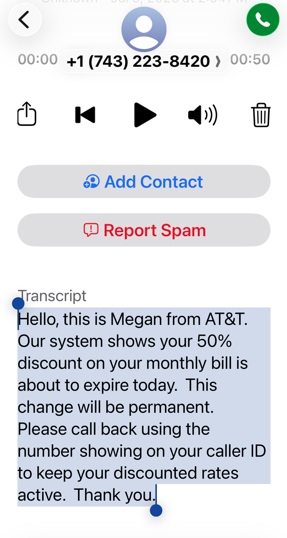
How you know it is a scam
- The voicemail script you received is identical to thousands of reported fake AT&T (and DirecTV) calls: “Hello this is Megan from AT&T... 50% discount on your monthly bill... about to expire today... call back using the number on your caller ID...”
- Legitimate companies like AT&T do not leave urgent voicemails demanding you call an unknown number shown on caller ID to “keep your discount.” Real promotions or account issues are handled through official channels, not high-pressure callbacks from random numbers.
- Scammers use this tactic to get you on the phone so they can:
- Ask for account PINs, Social Security numbers, payment details, or remote access to your devices.
- “Transfer” you to fake billing/upgrade departments and rack up unauthorized charges, gift card payments, or take over your account.
The number 743-223-8420 appears in scam reports and lookup sites associated with similar robocalls (numbers in the 743 area code are often VoIP/spoofed and used by scammers).
What to do right now
Just ignore it and block their number. Generally, it is helpful to avoid answering any calls you do not recognize, so you have time to consider and research any demands that might have been left on voicemail. There are now free phone apps that help to interecpt calls that are know to be coming from scammers. One that we have found to be very effective is TrueCaller. It displays any known information about callers as the calls come in, and alerts you about calls coming from numbers that others have reported to be scams.
- Block the number on your phone.
- Do not call it back - even out of curiosity. That connects you to the scammers.
- Check your actual AT&T account directly:
- Log in at the official AT&T website or app (att.com or MyAT&T app).
- Or call AT&T using the number on your bill or the official support page (not the one from the voicemail).
- If you have AT&T service, review recent bills for anything suspicious and consider enabling extra security features (like a PIN or two-factor authentication).
- Report it:
- FTC: ReportFraud.ftc.gov
- FCC: consumercomplaints.fcc.gov
- AT&T’s fraud page (they have specific warnings about these exact calls).
These scams have been circulating for years and spike periodically.
Apple offers the following advice:
If you get a suspicious phone call or voicemail:
Scammers spoof phone numbers and use flattery and threats to pressure you into giving them information, money, and even iTunes gift cards. Always verify the caller's identity before you provide any personal information. If you get an unsolicited call from someone claiming to be from Apple, hang up and contact us directly.
Tech support scams are an industry-wide issue where scammers use scare tactics to trick you into paying for unnecessary technical support services that supposedly fix contrived device, platform, or software problems.
Scammers may call you directly on your phone and pretend to be representatives of a software company. They might even spoof the caller ID so that it displays a legitimate support phone number from a trusted company. They can then ask you to install applications that give them remote access to your device. Using remote access, these experienced scammers can misrepresent normal system output as signs of problems.
Cybercriminals don't just send fraudulent email messages and set up fake websites. They might also call you on the telephone and claim to be from Microsoft. They might offer to help solve your computer problems or sell you a software license. Once they have access to your computer, they can do the following:
Trick you into installing malicious software that could capture sensitive data, such as online banking user names and passwords. They might also then charge you to remove this software.
More information
There are several websites that focus on reports of scam phone calls. See these pages for guidance as applicable to your specific situation:
- If you are certain you don't owe a debt: What to do about harassing phone calls
- If you may owe a debt: Debt collection phone calls - what they may do, what the may not do and how to stop them
- If you are being harassed by the collector: file a compliant against a debt collector with the FTC - Use this form to submit a complaint to the Federal Trade Commission (FTC) Bureau of Consumer Protection about a particular company or organization..
- How to stop telemarketers
Related Scams
There are a number of common telephone scams, such as:
and some new and as yet, uncommon scams.
Information About Specific Phone numbers
There are several websites that focus on reports of scam phone calls. See these:
For a comprehensive list of national and international agencies to report scams, see this page.