FedEx Scam Email - We're very sorry your package was lost
Scammers NEVER stop trying to scam you. This email, claiming to be from FedEx saying "We're very sorry your package was lost"
or "Really sorry your package did not arrive" is
an obvious fraud.
For one thing, all the links go to http://www.calmde.com/ Does that sound link FedEx to you?
FedEx is the lastest subject of the
scammers. 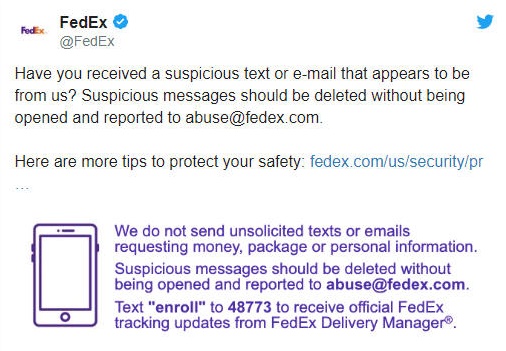 In this new scam you get an
email with your name
from Fedex (or another delivery service) and a tracking number. There is a link to click on (DON'T) to "set your delivery preferences. Do not click on the link.
Whenevert you have any questions about a tracking number, go to the main website of the shipping company and search the tracking number yourself!
In this new scam you get an
email with your name
from Fedex (or another delivery service) and a tracking number. There is a link to click on (DON'T) to "set your delivery preferences. Do not click on the link.
Whenevert you have any questions about a tracking number, go to the main website of the shipping company and search the tracking number yourself!
NEVER click on the links in the email, nor respond to it. Just delete it. If you hover over the link
the email you receive, you will see it goes to some website you have never heard of, like:
http://www.calmde.com/
FedEx sent out a warning via Twitter about the scam. At right (or below) is an example screenshot of the FedEx's warning about the scam..
Also see
And here is one version of the scam:
-------- Forwarded Message --------
|
FedEx
Service update and goodwill resolution
|
|
|
Shipment issue resolution
|
|
A premium gift, offered as our apology.
|
|
Your recent package loss fell short of the standard you should expect from
FedEx. To make this right, you may choose one complimentary gift: AirPods,
Apple Watch, or Beats by Dre headphones.
|
|
AirPods
Compact, versatile, and easy to claim.
|
|
|
Apple Watch
A premium everyday upgrade at no cost.
|
|
|
Beats by Dre
Bold sound and a clear gesture of goodwill.
|
|
|
|
|
|
What this includes
Complimentary product selection from three premium options.
Direct shipment to your address on file.
Secure claim flow
designed to verify eligibility quickly.
|
Support details
No payment is required.
This is a goodwill gesture from FedEx.
Please submit your selection within 14 days to keep your claim
active.
|
|
|
Next steps
Review the available gift options, complete secure verification, and
confirm delivery details. Once submitted, your selected item will be
prepared for shipment to the address we have on record.
|
|
|
Select Your Complimentary Gift |
|
FedEx exists to reduce friction in moments that matter. When a shipment does
not arrive as expected, the service has not fulfilled its central purpose:
moving shipments with reliability, clarity, and care. This resolution is
meant to respond to that interruption in a way that feels concrete and
respectful.
|
|
The selection of AirPods, Apple Watch, or Beats by Dre headphones reflects
that intent. These are recognizable, high-value products chosen to turn a
frustrating service outcome into a better final impression, without adding
cost or complication to the recovery process.
|
|
Across every delivery touchpoint, FedEx aims to balance speed with trust.
That standard matters most when service falls short. This offer is a simple
expression of that responsibility: a clear apology, a direct remedy, and an
easier path forward.
|
|
|
FedEx Customer Support
This claim window remains available for 14 days from
receipt of this notice.
|
|
Another version:
|
Service recovery notice: a complimentary premium gift is available for 14
days as part of this resolution. |
|
|
FedEx
|
|
Member Resolution Benefit |
|
A premium apology for a delivery that should have arrived. |
|
FedEx sincerely regrets the inconvenience of your lost package. To
make this right, you may choose one complimentary gift at no cost:
AirPods, an Apple Watch, or Beats by Dre headphones. |
|
|
|
This offer is intended as a direct gesture of goodwill. The process is
simple: review the available gift options, complete secure verification, and
confirm shipment to the address on file. |
|
To keep the resolution straightforward, one selection is available per
eligible recipient and must be claimed within 14 days. |
|
|
Premium gift comparison |
|
Option |
Best for |
Included value |
|
AirPods |
Everyday listening and calls |
Fully complimentary |
|
Apple Watch |
Daily organization and wellness |
Fully complimentary |
|
Beats by Dre |
Immersive sound and travel use |
Fully complimentary |
|
|
|
Why this step matters |
|
Secure verification helps confirm eligibility and ensures your
selected gift ships correctly to the address already associated with
the impacted delivery. There is no purchase required and no fee for
fulfillment. |
|
|
| Choose Your Gift
Offer window closes 14 days from receipt of this notice.
|
|
FedEx has long stood for dependable movement, careful handling, and visible progress
from sender to doorstep. When that chain breaks, the expectation is not simply an
explanation but a meaningful response that reflects the seriousness of the service
entrusted to the brand. |
|
This complimentary gift offer is designed around that principle. Rather than a
generic statement, FedEx is extending a tangible choice: premium audio or wearable
technology that feels useful, current, and worthy of the inconvenience experienced.
|
|
AirPods, Apple Watch, and Beats by Dre each represent everyday utility paired with
premium design. The goal is simple: turn a frustrating shipment outcome into a
recovery experience with clarity, respect, and practical value. |
With sincere apologies,
FedEx Customer Support |
 |
|
What to do:
- Send us a copy by copyting and pasting it into the
reporting form here:
- Report it to FedEx by forwarding it to abuse@fedex.com.
- You can also report it to the Internet
Crime Complaint Center
- and to
your state Attorney General's office.
FedEx's Warning and help
FedEx, on their website here, http://www.fedex.com/ng/about/fraudulent_use.html, says:
- Watch for text messages or emails saying there's a problem with your FedEx shipment.
- Use secure payment methods to pay for your shipments. Don't wire money or send money orders or cash.
Using secure payment methods also makes it easier to dispute a fraudulent charge.
- Keep your FedEx account and credit card numbers safe, and don't share them.
- Avoid using public computers to send sensitive information or log in to your accounts.
- Update your computer, browser, and software as needed.
Unauthorized use of FedEx� Business Names, Service Marks and Logos
FedEx has been alerted to the unauthorized use of its business names, service marks and logos by persons or companies fraudulently
representing themselves as FedEx or as representatives of FedEx.
Millions of fraudulent e-mails and sms messages are deployed daily. They claim to come from a wide variety of sources, and some claim to be from
FedEx or representing FedEx. Fraudulent e-mail and sms messages, often referred to as "phishing" or brand "spoofing," are becoming increasingly
common. These types of messages often use corporate logos, colors and legal disclaimers to make it appear as though they are real. They are sent
in an attempt to trick people into sending money and providing personal information such as usernames, passwords and/or credit card details, and
for the purpose of committing theft, identity theft and/or other crimes.
Recognizing Phishing Scam E-mails and sms messages
Recognizing phishing scam e-mails and sms messages is key to protecting yourself against such theft and other crimes. Indicators that
an e-mail or sms message might be fraudulent include:
-
Unexpected requests for money in return for delivery of a package or other item, personal and/or financial information, such as your Social
Security number, bank account number, or other identification.
-
Links to misspelled or slightly altered Web-site addresses. For example, variations on the correct Web-site address fedex.com, such as
fedx.com or fed-ex.com.
-
Alarming messages and requests for immediate action, such as "Your account will be suspended within 24 hours if you don't respond" or claims
that you've won the lottery or a prize.
-
Spelling and grammatical errors and excessive use of exclamation points (!).
FedEx does not request, via unsolicited mail, e-mail or sms messages, payment or personal information in return for goods in transit or in FedEx
custody. If you have received a fraudulent e-mail or sms message that claims to be from FedEx, you can report it by forwarding it to abuse@fedex.com.
If you have any questions or concerns about services provided by FedEx, please review our services at FedEx
Services or contact FedEx
Customer Service.